Wow...March has been a busy month! As a student at TC, I've had the opportunity to attend all of the workshops offered by the Reading and Writing Project for free (though if you account for the insane tuition, I wouldn't exactly call it free)! The staff developers - Lucy Calkins, Kathy Collins, Rebecca Cronin, Amanda Hartman, Natalie Louis, Christine Holley - are ALL absolutely fabulous and I'm learning so much from them. I feel so lucky to be learning directly from the masters themselves! Below are just a few of the ideas I've gotten from their workshops.
Reading Goals & Assessment
Running records provide us with important data about where each child is and where we need to take them next. It's important not only to note the child's accuracy but also to determine which cueing systems she is using (meaning, structure, visual). If the child is using mainly visual cues then we know we need to work with her on using meaning and structure to figure out unknown words. Once we have our assessment data, we can create individual goals for students. Here's one simple idea for a goal sheet to help kids keep track of their own reading goals. Just write their goals on a post-it and when they master the skills, they can move the note over to the right side of the chart. Click here to download the
Reading Goals Sheet.
One quick and easy way to assess comprehension is to use "stop and jot" or "stop and sketch." To do this, we simply pause at certain points in a read aloud and ask the kids to write or draw their thinking. The prompt should be related to a strategy you're working on with them. For example, when working on predicting, I would ask them to draw/write what they predict will happen next. You can also have kids add their notes from their independent books and collect the sheets for an informal assessment. Click here for the
Sticky Notes Organizer.
Another tool I loved was this Reading Stamina Rubric. With this tool,
students self-assess their own stamina during reading workshop. I would
create a large version to hang in the classroom for an anchor chart and
then have students keep copies in their reading baggies/boxes. You can
grab a copy of my version of the
Reading Stamina Rubric here.
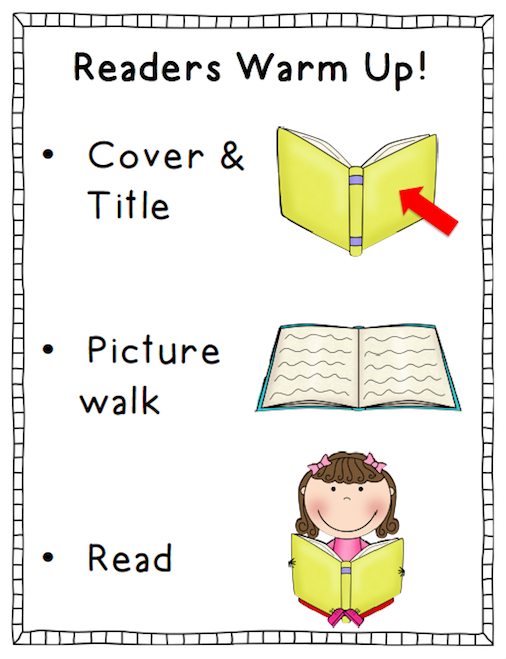
Readers Make a Plan
Buddy Reading Folders: When students are
reading with partners, it is important that they have meaningful work to
do and that they know what is expected. Rather than giving an
assignment or task, it's better to provide a repertoire of activities
that they can do repeatedly. This way we won't hear "We're finished"
after two minutes! This partner reading folder was introduced to me by
the lovely ladies at TCRWP. I loved the idea and just HAD to make my own
version! You can download the
Buddy Reading Folder here.
Anchor Charts: Here are some simple
charts you can print out or make with your kids.
Word Solving Strategies
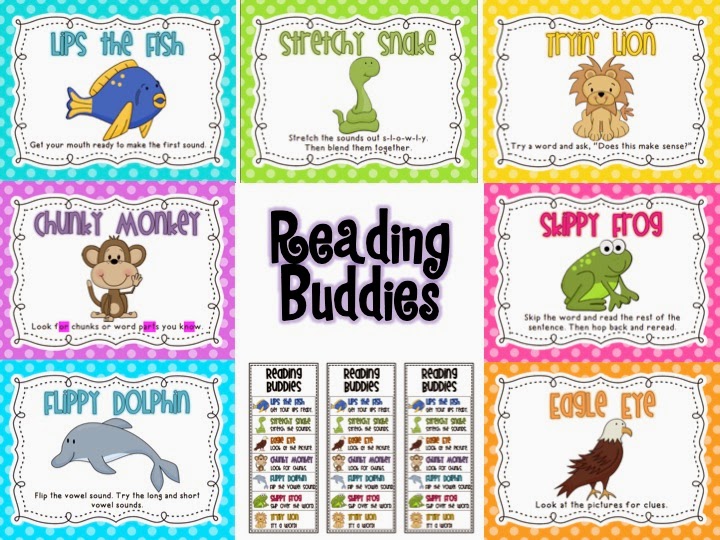
We talked a ton about reading strategies and different little tricks to help kids remember them. One trick I've used (which I know is not at all original) is the beanie baby reading buddies. For example, Lips the Fish reminds kids to get their mouth ready to make the first sound in the word. I know there are tons of these posters around the internet, but I just had to make my own set to match my polka dot theme! I'm planning to give each student a bookmark and clipping a paperclip on the strategy they currently need to work on. You can download my
Reading Buddies Posters here.
Strategies for ELLs
Here are just a few random tips I've picked up for working with ELLs. One of the staff developers recommended the book
Balancing Reading & Language Learning, and it has provided me with tons of useful info for ELLs.
Of course, these kiddos need to hear and use language a LOT in order to develop their English proficiency. So we need to make sure we are giving them plenty of opportunities to talk! We should encourage and praise their efforts, even if they aren't correct. Rather than pointing out errors, simply model the correct language. Rather than calling on one student to answer a question, we should elicit choral responses or turn and talk so that all students get a chance to respond. We should also incorporate topics and books that are familiar to them so they can successfully participate and contribute to discussions. Anyhow, here are a few activities for stimulating language development...
Oral Storytelling: This is a great activity to use during shared reading or guided reading. First, cover up the text with sticky notes. Then have the kids orally generate the story using their own words by looking at the pictures. After they read a page, we can pull off the sticky note and compare their "text" with the actual text on the page. This is great for oral language development as well as knowledge of story structure. Plus, even if kids can't yet read text, this gives them a chance to participate and feel like real readers!
Speech Bubbles: This little trick is great for shared reading or partner reading. All you need to do is draw some speech bubbles or thought bubbles on sticky notes and place them in the book. After reading the text, the kids infer what the characters are thinking or saying.
Class Books: Creating class books or big books is also fantastic for ELLs. Predictable charts can be created in shared/interactive writing and then turned into a class big book. After writing, cut up the chart and give each child his sentence. The kids cut and paste their sentence onto a page and illustrate it. Then the pages are combined into a book and added to the class library. Here's a sample of a big book I made last year with my class. We created the text in shared writing and then the kids worked with partners to illustrate it.
Word Books: A super easy activity for vocabulary development is to print out some Google images related to a theme (e.g. families, food, animals). You could also use actual photographs taken in the classroom. Staple the pages together and have the kids generate the text for each page in shared/interactive writing. Then add the book to the class library!
That's all for now! I'm working on a guided reading post for next week, so check back for some more freebies ;)






.png)


